Personal projectsYoMaxi
YoMaxi: Making everyday progress feel rewarding.
Founder, Product Creator & Creative Lead · a companion-led life-organisation app
A life-organisation app that brings goals, habits and tasks across the areas of life into one daily loop with a friendly sidekick, under active development.
- Role
- Founder, Product Creator & Creative Lead
- Period
- September 2026 – present
- Stage
- In development
- Team
- Solo project, built with AI assistance
- Audience
- People who want one place for their goals, habits and everyday responsibilities and enjoy a more playful, character-led approach to organisation (a broad intended audience; no launch segment has been validated yet).
- Capabilities
- Links
YoMaxi started as something I wanted for myself: one place to organise the parts of life that matter and stay consistent with them. I built it around goals, habits and tasks, with a friendly sidekick, achievements and levels. It began as LifeOS, is under active development and is not yet released.
How it is being built
Six stages of the classic product cycle, from a personal brief to a build in progress; AI works with me at each one, and the decisions and the quality bar are mine.
Ideation and screening
The brief was a list of ordinary, easily neglected commitments (appointments, water, supplements, walking, saving, birthdays) that I wanted in one view of life and progress.
- My role
I wrote the brief and framed the problem: the areas of life, the role of gamification and the integrations I wanted.
- Decisions
- Goals, habits and tasks, so that every action links to a larger objective.
- Life areas, not one list, because a single list was the problem.
- Gamification in support, not in charge, because the aim is real-life action.
- Outcome
The LifeOS concept: connect everyday actions to larger objectives and make progress visible across the areas of life.
- Challenges
Breadth: an app that spans every area of life can become a list of everything, and a list was the problem.
Product definition and planning
The specification ran from v0.1 on 5 September to v0.3 on 12 September: product brief, React Native and Expo engineering baseline, and the AI-assisted workflow.
- My role
Product owner: I set the questions, chose the priorities and decided what each version committed to, with AI drafting alongside.
- Decisions
- One habit, offline, rewarded once, first, because that is the hard part.
- Offline-first with an outbox, because core actions must work without a connection.
- Calendar and health integrations behind spikes, because I promise nothing unproven.
- Outcome
A specification to build from: domain model, scoring and sync rules, fourteen acceptance scenarios, five milestones and a marketing strategy draft.
- Challenges
Deciding what stays out: bank aggregation, medical recommendations, social feeds, leaderboards and an LLM coach all sit outside the MVP.
Design and prototyping
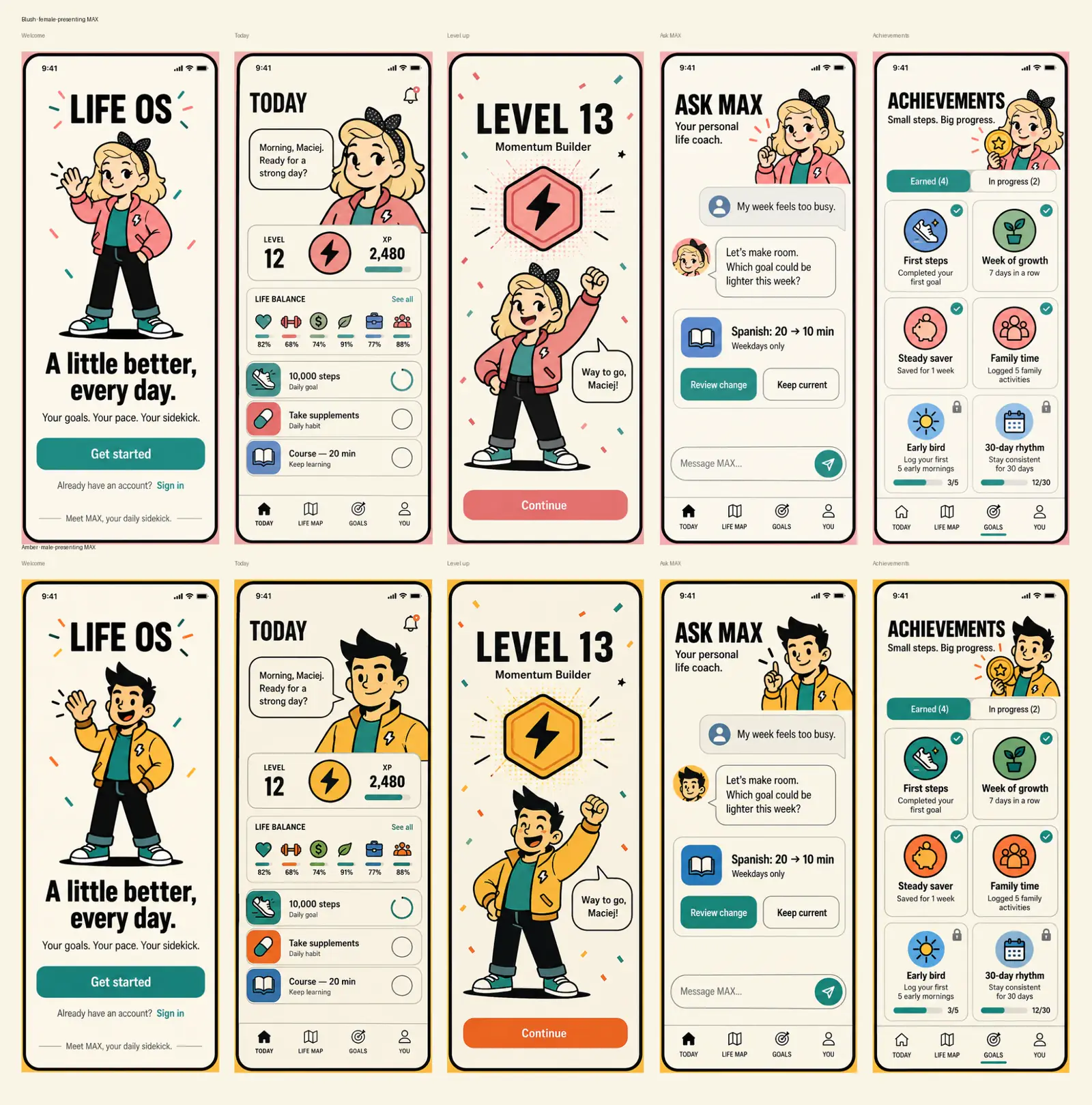
I moved the early tactical, game-inspired direction to a flat, minimal cartoon look: Maxi on a warm cream canvas, two themes, one component set.
Concept
The accepted reference boards: Welcome, Today, Level up, Ask MAX and Achievements in Blush (top) and Amber (bottom), still under the LifeOS working title.
Actual
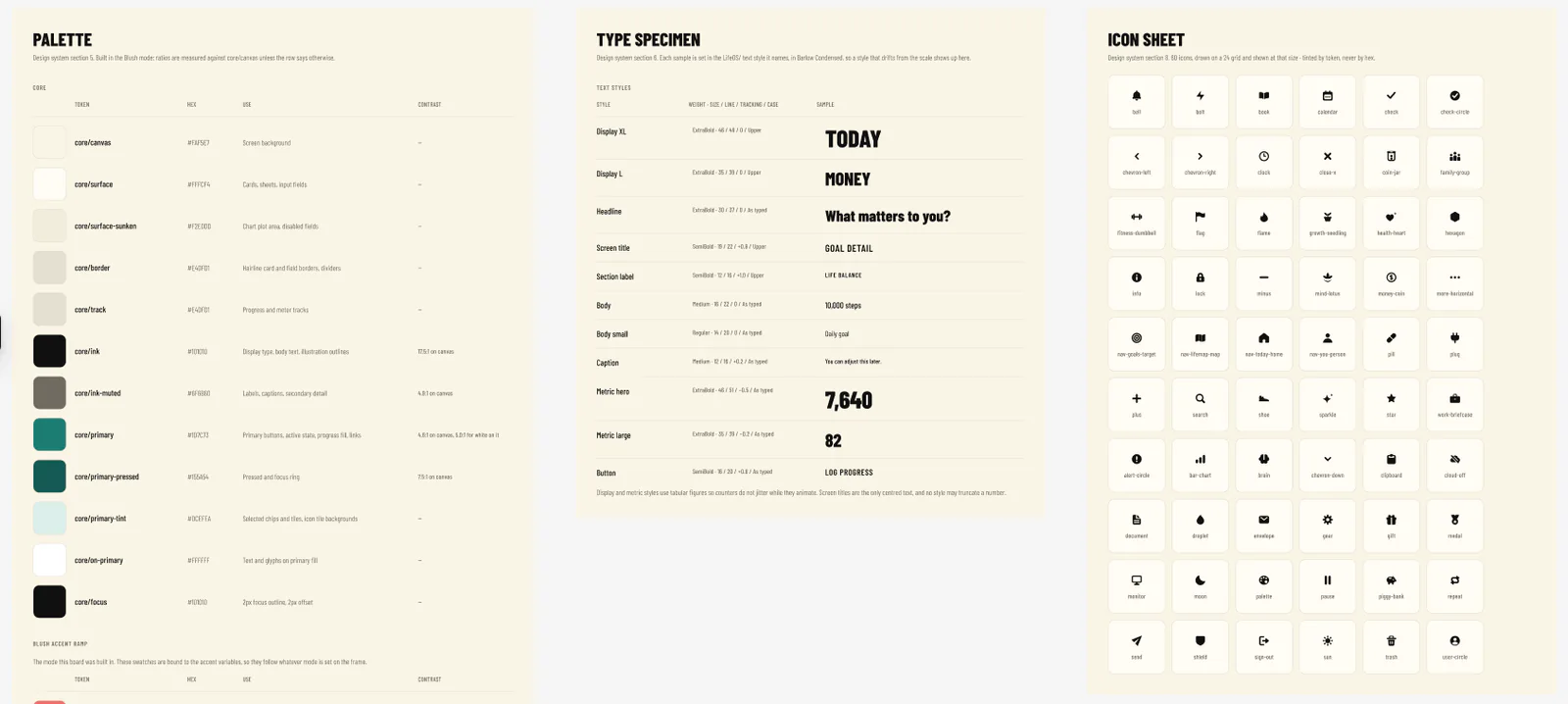
Foundations: palette with contrast ratios, type specimen, icon sheet, space and shape.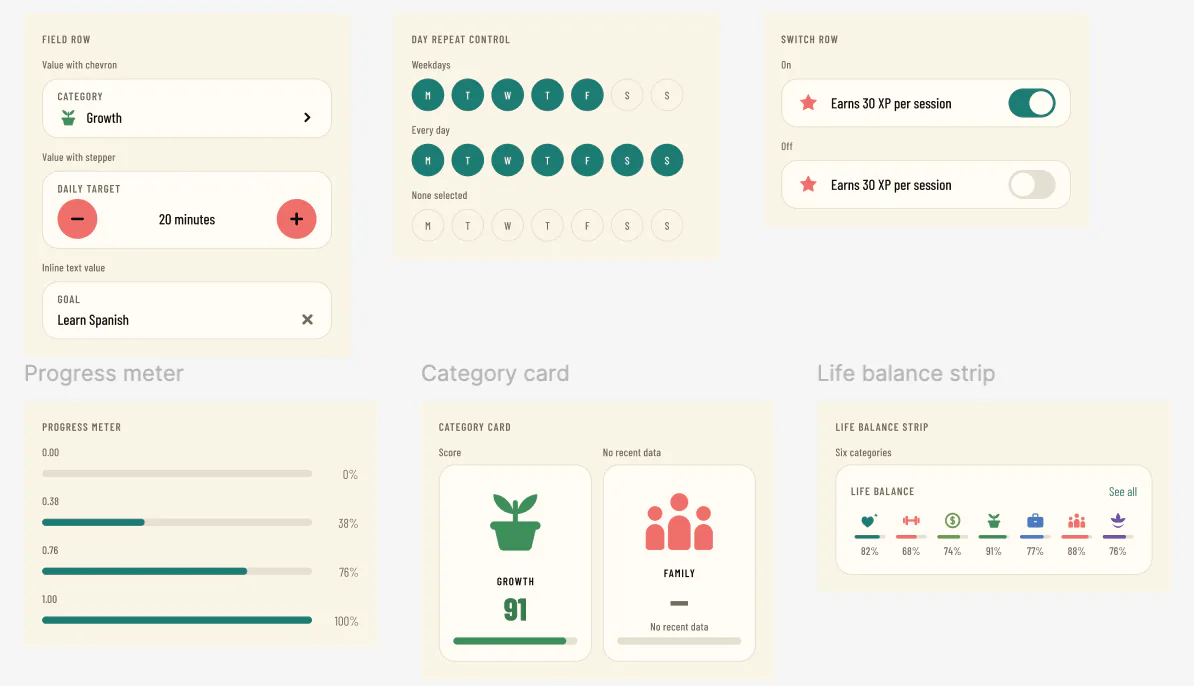
Actual
Components: one set shared by the Blush and Amber themes (field rows, day repeat control, switch row, progress meter, category card, life balance strip).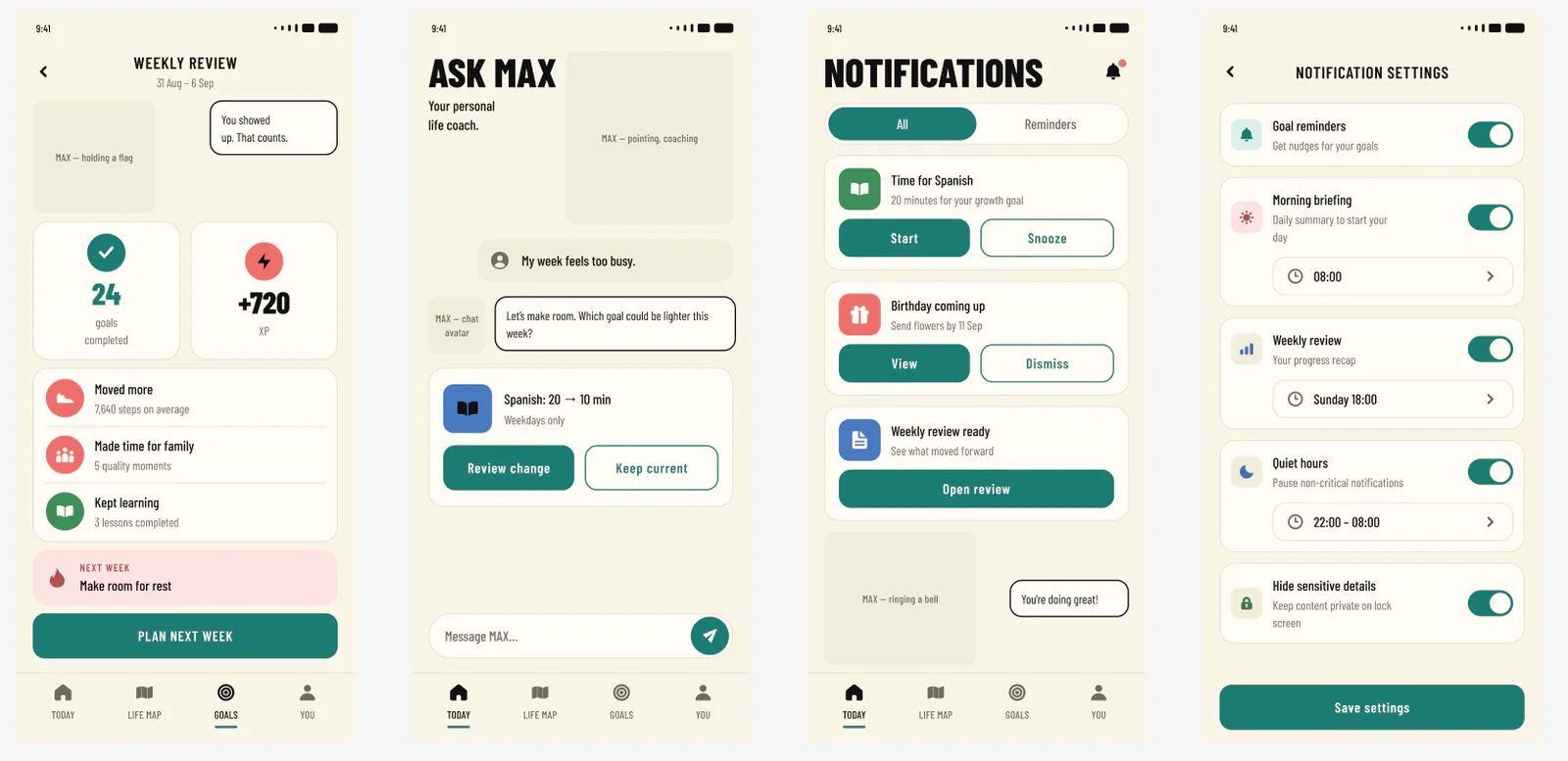
Actual
Screens: four of the thirty-nine (Weekly review, Ask MAX, Notifications, Notification settings).
- My role
Creative direction and design system: I set the brief, directed each revision and built the brand book, components and screens in Figma.
- Decisions
- Flat cartoon, not tactical, because personality must not cost clarity.
- Both companions on the welcome screen, so that the choice is real.
- One component set for both themes, so that nothing depends on the choice.
- Outcome
A full design system in Figma (brand book, foundations, components and thirty-nine screens) that every screen since is built against.
- Challenges
Staying age-independent without a toy-shop feel; and production artwork for Maxi, every pose at three densities, is still outstanding.
Validation and testing
Validation so far is engineering validation: test-first feature work, fourteen mandatory scenarios and CI gates; no user testing has run yet.
- My role
I set the quality bar (no duplicate rewards, durable offline writes, account isolation) and the scenarios that prove it.
- Decisions
- Never reward the same completion twice, because progress must stay believable.
- Consistency apart from lifetime XP, because past effort and current routines differ.
- Test-first for every domain rule, because a green build must mean something.
- Outcome
Fourteen scenarios, QA-01 to QA-14, from a retried completion to a time-zone change; the main branch protected behind three required checks.
- Challenges
Historical CI runs still show failures, and the XP values, seven-day window and reminder defaults await user testing.
Development
Foundation, slice and core build, with Claude Code as coding assistant: one habit completed offline and rewarded once, then programmes, goal steps and money on top.
Actual
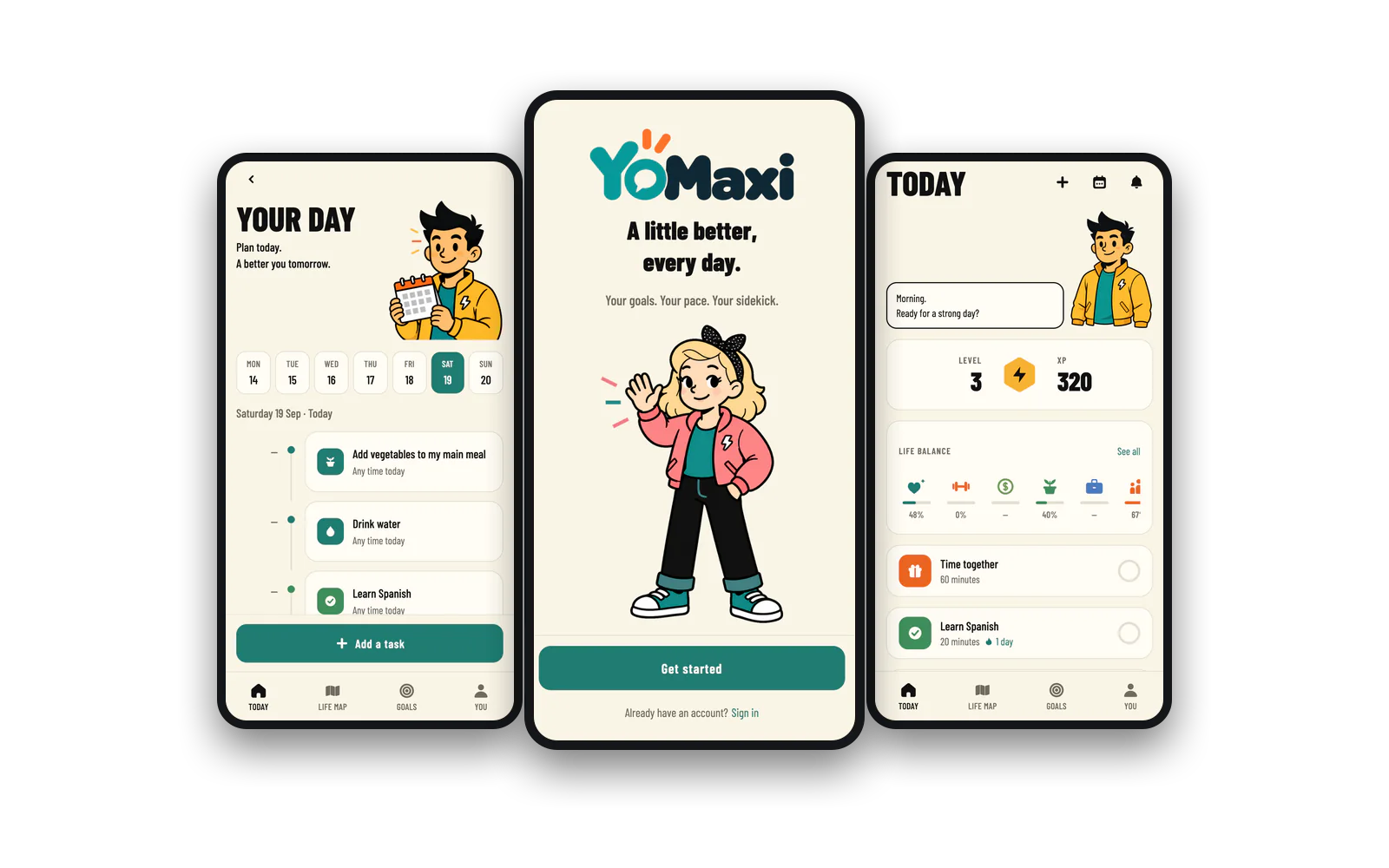
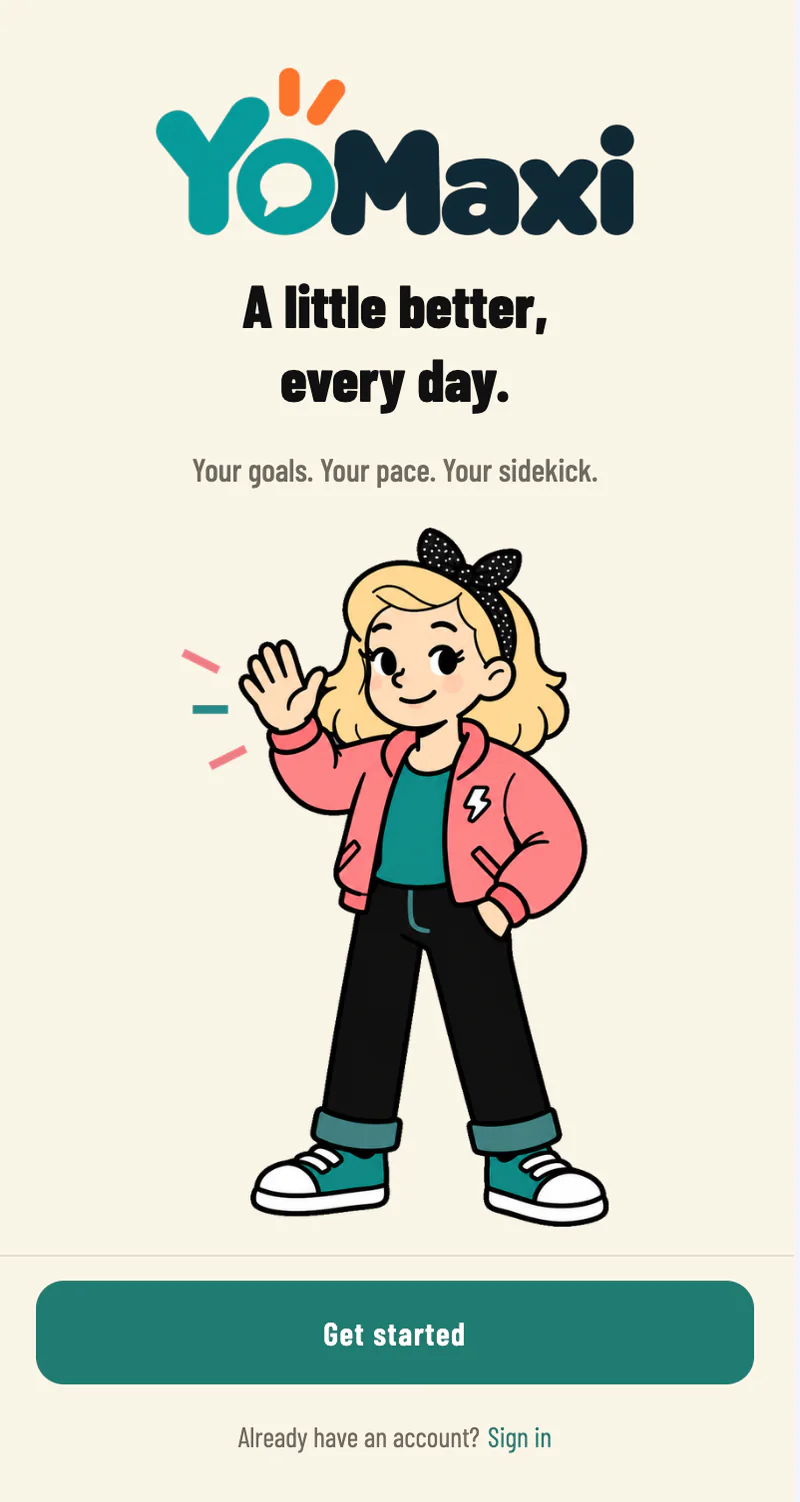
Welcome: the wordmark, “A little better, every day.” and Maxi in the Blush theme.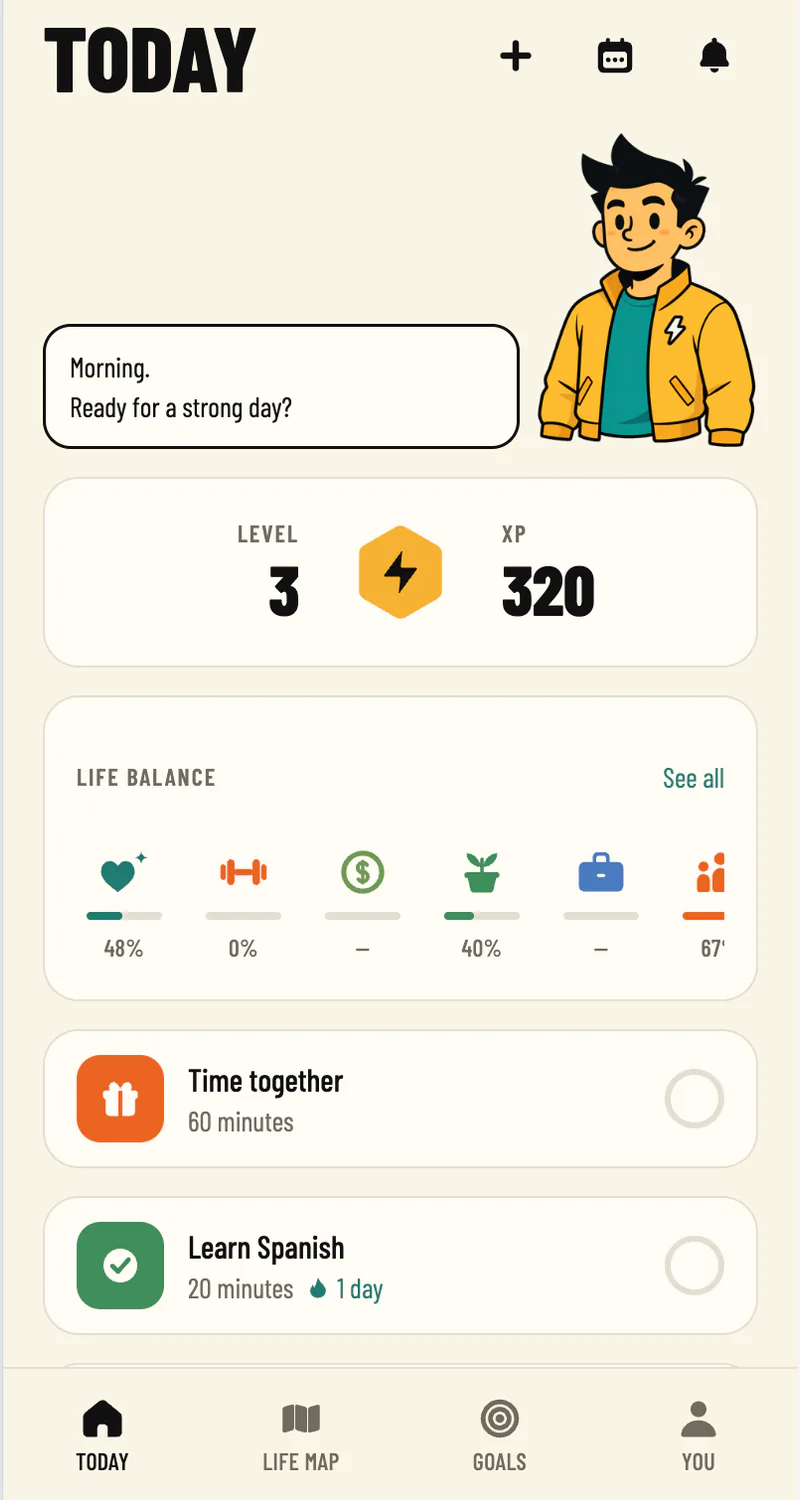
Actual
Today: Maxi in the Amber theme, level and XP, the life-balance strip and the day’s habits.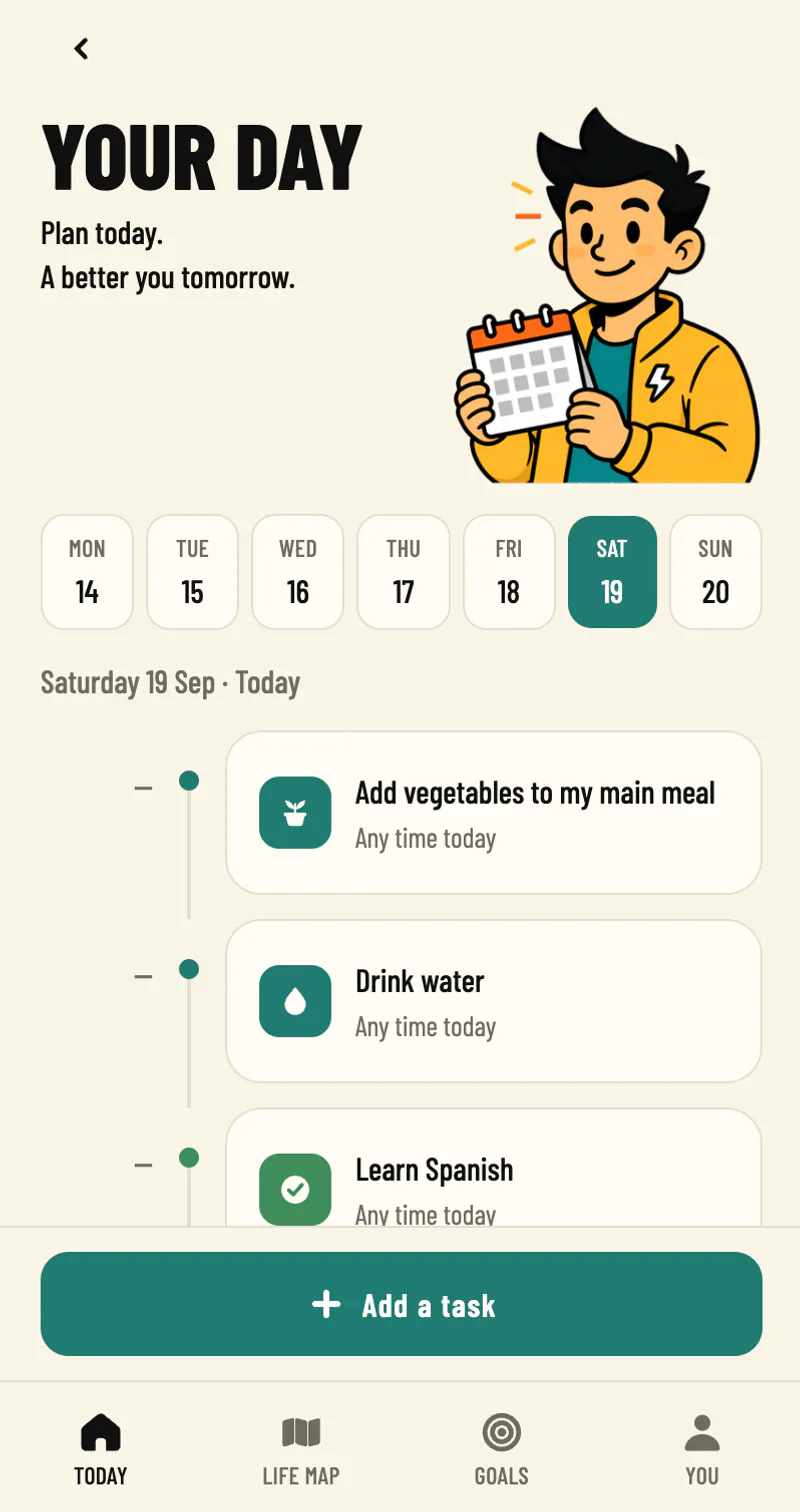
Actual
Your Day: the week strip, today’s habits and tasks on a timeline, and Add a task.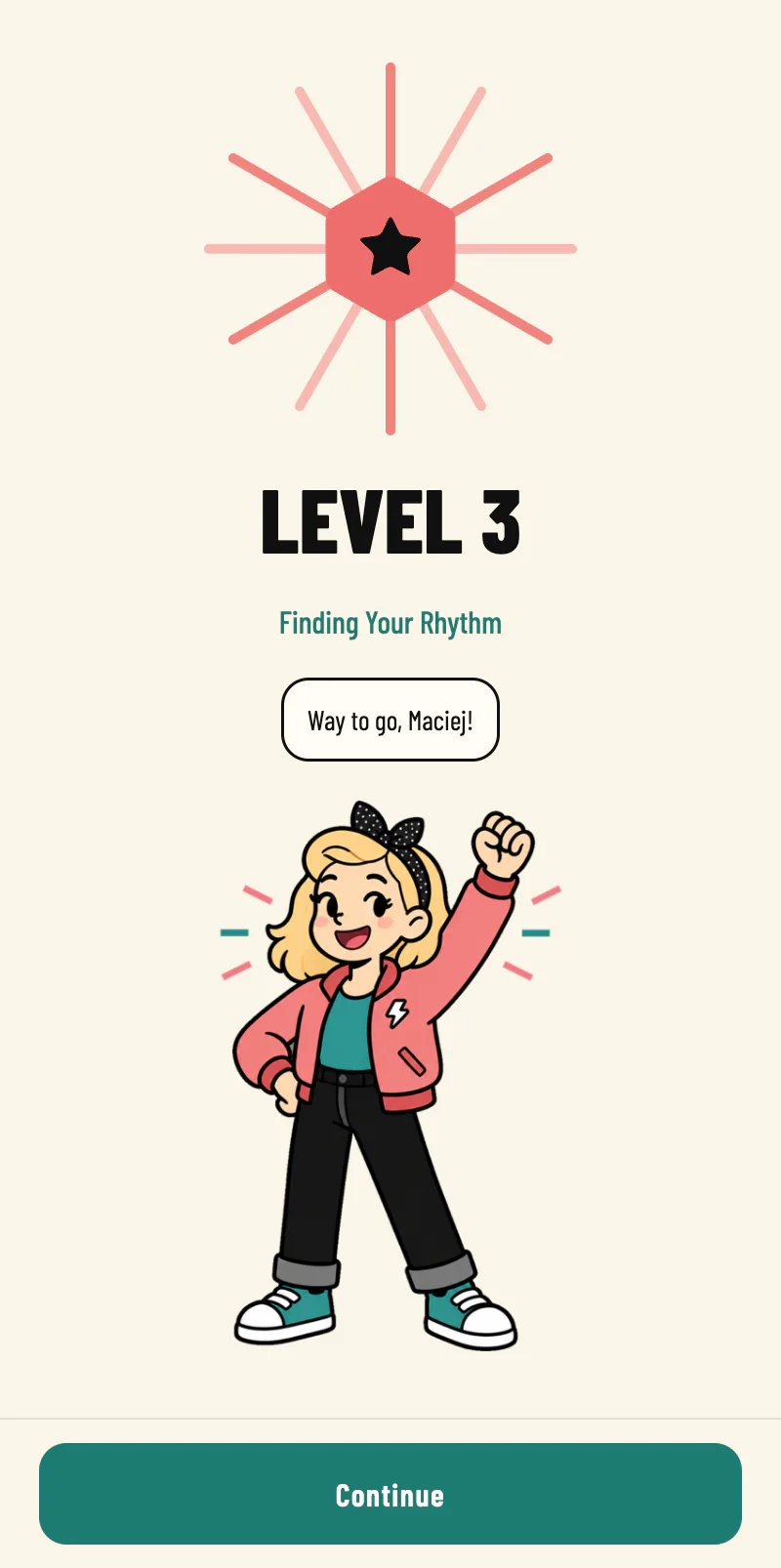
Actual
Level up: the badge, the level title, a word from Maxi and Continue.
- My role
Engineering lead with AI-assisted implementation: I choose the next slice, decide what is startable and review the diffs.
- Decisions
- Custom sync through an Edge Function, so that client and server share one contract.
- A plan is a queue, not a calendar, so that a missed day waits.
- Money by hand first, because spending by category waits on a bank feed.
- Outcome
Core loop, plans, programmes, projects, events and reminders on Supabase EU; 2,022 tests on every change; a release APK in CI.
- Challenges
iOS has never been compiled, so cross-platform is unproven; meal and event sync is written but not deployed.
Launch and commercialisation
Ahead, with no dates: a core beta with users, an integration beta and release readiness; the brand and the two commercial concepts are the preparation so far.
Actual
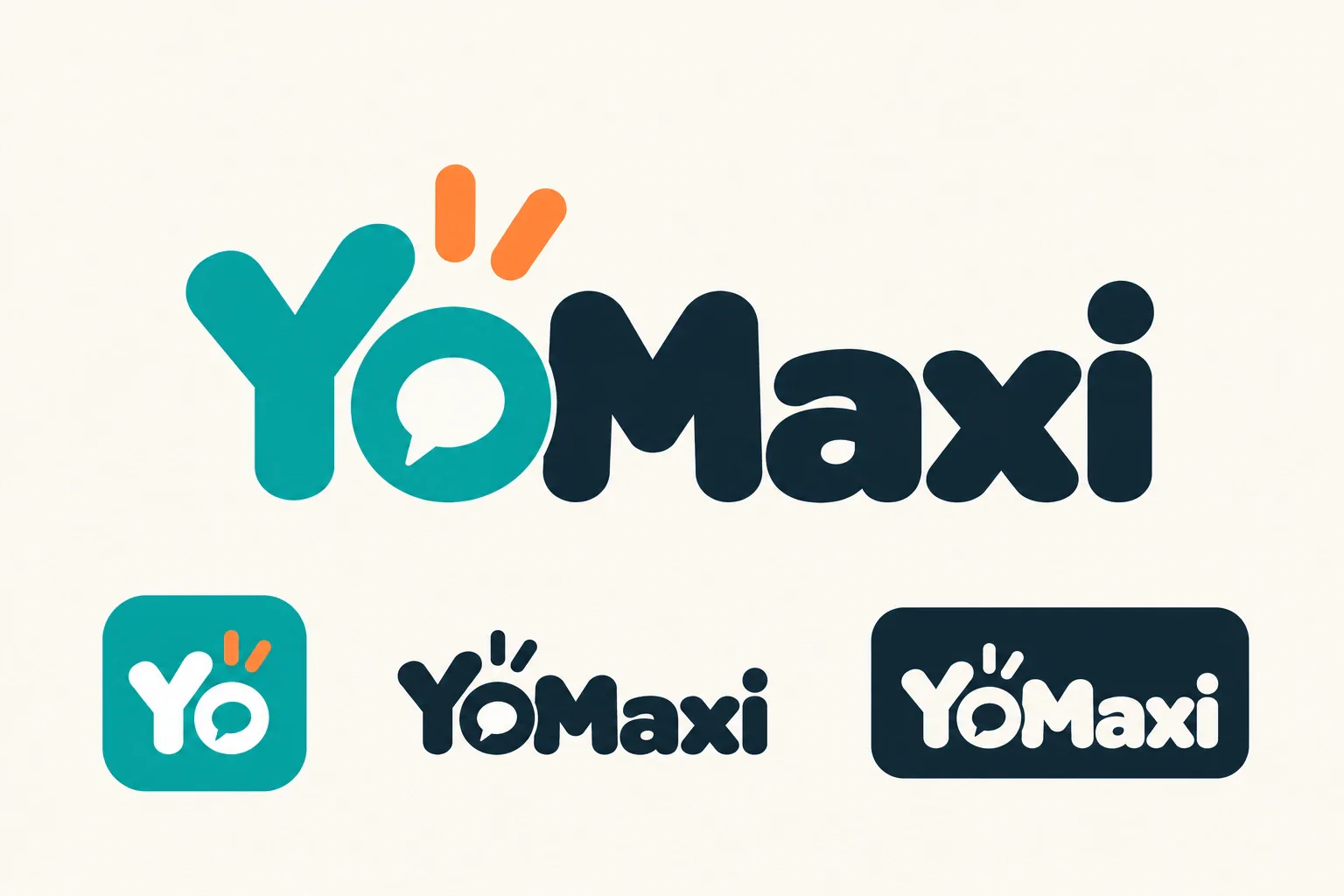
The brand sheet: the full-colour wordmark, the compact app-icon mark and the navy variants.
Actual
The compact logo: the “Yo” speech-bubble mark on its own.
Concept
Promotional concept one: a student greets the app and Maxi appears as a miniature hologram (an advertising idea, not an app feature).Concept
Promotional concept two: at home, the app opens and Maxi rises from the screen over the table (the same idea in a quieter setting).- My role
Brand and promotion direction: AI explored names, logos and commercial concepts; I chose YoMaxi and directed the narrative and character.
- Decisions
- YoMaxi, Maxi as the companion, because the name is the greeting.
- Lead with the sidekick, not features, because the emotional idea comes first.
- The hologram stays an advertising effect, so that nobody reads it as a feature.
- Outcome
A usable identity (wordmark, compact logo, three variants) and two commercial concepts; no beta, listing or users yet.
- Challenges
Distinctive without becoming childish took four working names; a name is not a clearance: no trademark is established.
What exists today
- 7life categories
- 2themes, one component set
Product model and brand
- Goals, habits, tasks and calendar events across seven life categories; Mind & Balance added as the seventh
- Brand: YoMaxi, its companion Maxi, two complete themes sharing one component set
Built so far
- Core loop: create a daily habit, complete it offline, see provisional XP, restart, sync, undo (never rewarded twice)
- Training plans; goal steps with milestones; first-tier money tracking
- Programmes for nutrition, Mind & Balance and Family & Social
- Work category built around projects, with setup templates that create and let go rather than enrol
- Events with reusable checklists that become real dated tasks
- Task reminders, quick capture, a daily priorities pick
- Today screen groups tasks under their programme, project or event; a programme task says why it is there
- Meal recording, with food-packet barcodes looked up on Open Food Facts
- A launch page that takes waitlist sign-ups
Active development. Not released: no store listing, no public beta, no users, no retention or wellbeing figures. Calendar and step-tracking integrations are planned; Ask Maxi ships as a static screen.
Technical specs
- 68screens
- 2,022tests per change
- 375rendered tests
- 20migrations
- 3required checks
Platforms
- Android: built and run on an emulator and on my own phone; CI builds a release APK for the nightly device tests
- iOS: configured under the same bundle ID, not compiled yet
- Web: a development preview through react-native-web, with data held in memory
App
- Expo SDK 57, React Native 0.86, React 19.2 and TypeScript 6 in strict mode
- Expo Router with typed routes: four tabs, then modal, onboarding and account groups
- SQLite on the phone through expo-sqlite; the session in secure storage
- Local reminders planned seven days ahead, at most 60 pending; no server push
- English only for now, with dates, counts and money formatted through Intl
Architecture
- An npm workspaces monorepo: the app plus domain, contracts and theme packages
- Domain rules are pure functions with no clock and no randomness, so the phone and the server run the same code
- Offline first: a change and its outbox entry commit in one SQLite transaction
- Sync pushes and pulls at sign-in, when the app comes back to the front and every 60 seconds while it is open
- A Supabase Edge Function on Deno checks each batch against the shared contract and works out XP on the server
- A retried operation comes back as a duplicate; an edit made against an old version is refused as a conflict
Backend
- Supabase in the EU: PostgreSQL, Auth, and Edge Functions for sync and the launch-page waitlist
- Row-level security on every user table, so one account cannot read another's rows
- A unique index allows one reward per source; an undo appends a correcting entry and deletes nothing
Quality and CI
- Node's built-in test runner across six suites: domain, contracts, schema, theme, app and rendered screens
- Migrations tested against real PostgreSQL compiled to WebAssembly (PGlite)
- Screens mounted through react-native-web; a gate fails when a new screen has no rendered test
- GitHub Actions on every change: a typecheck, a design-token drift check and coverage floors
- Line coverage floors of 99% for the domain rules, 97% for app logic and 92% from the rendered tests alone
- Seven Maestro flows written for a nightly Android emulator job, which is not passing yet
Design system
- One design token file in the W3C format, compiled into the theme module the app imports
- A custom Figma plugin builds the Figma library: variables with a Blush and an Amber mode, text styles, components and screens
- Barlow Condensed throughout, and a set of 60 icons
From the LifeOS repository, main branch, 4 October 2026. The test figures come from a full run of that commit.
Learnings
- Passing tests were not the same as a working screen. Several defects shipped with typecheck and unit tests green and were found only by rendering, so 375 tests mount real screens and a gate catches any new screen without one.
- Coverage was built in layers, each catching what the others could not: rendered screens, paired store tests across SQLite and memory, schema tests against real PostgreSQL, and structural gates that turn an invisible gap into a red test.
- No fix counted as proven until it was reverted and the test failed. That discipline exposed tests that could not tell the difference and guards that were never load-bearing.
- Some failures only a device shows. Each time one did, the test harness was made able to catch the next.
- Completion is reported screen by screen, after a design was recorded as shipped with half its screens unbuilt.